
Master Public Speaking (Even If You're Terrified of It)
Dr. Alexander McWilliam


From Gamer to Web3 Disruptor: How Amos Whitewolf Is Rebuilding Gamer Trust with PerionXP
Amos Whitewolf

From 0 to $25M ARR Bootstrapped: Adam Robinson’s Blueprint for SaaS Growth Without Funding
Adam Robinson


How to Scale as a CEO – Mindset, Strategy & Leadership Shifts, with Joe Leech, CEO Coach
Joe Leech


From Corporate Lawyer to Social Impact Entrepreneur: Sanjay Lobo's Journey with OnHand
Sanjay Lobo


From Premier League Star to Wellness Entrepreneur: Thomas Robson-Kanu's Journey with The Turmeric Co
Thomas Robson-Kanu

Master Public Speaking (Even If You're Terrified of It)
Dr. Alexander McWilliam
From Gamer to Web3 Disruptor: How Amos Whitewolf Is Rebuilding Gamer Trust with PerionXP
Amos Whitewolf
From 0 to $25M ARR Bootstrapped: Adam Robinson’s Blueprint for SaaS Growth Without Funding
Adam Robinson
How to Scale as a CEO – Mindset, Strategy & Leadership Shifts, with Joe Leech, CEO Coach
Joe Leech
From Corporate Lawyer to Social Impact Entrepreneur: Sanjay Lobo's Journey with OnHand
Sanjay Lobo
From Premier League Star to Wellness Entrepreneur: Thomas Robson-Kanu's Journey with The Turmeric Co
Thomas Robson-Kanu
Branding
AI
Tech
13 min read
We asked AI about four brands. Only one sounded like itself.
What ChatGPT, Claude and Perplexity say about Ramp, Harvey, Wiz and Docusign, and what it tells you about your own brand.
Every founder has typed their own company name into ChatGPT and asked what it does. Most did not enjoy the answer.
The standard explanation is that the models are out of date and have not caught up. A whole industry has grown around that idea in about eighteen months, promising to get the models saying the right thing about you through schema markup and technical fixes.We wanted to test the premise. We took four companies in the middle of a repositioning, asked the models a set of questions about each, and then read everything those companies say about themselves.
The models were not out of date. They knew the new story in every case. It just was not the answer they gave first.
How we ran it
Five questions per company, put to ChatGPT, Claude and Perplexity in September 2026. We then read every surface each company uses to describe itself: homepage hero and subhead, browser tab title, meta description, both app store listings, press release boilerplate, the press page, and the category entries on Wikipedia and G2. Company surfaces were captured on 11 September 2026.
One caveat [to keep in miind][we would rather state than bury]. Our model answers are single captures. Ask the same question twice and you will often get two different answers, because these systems are not deterministic and because ChatGPT searches the live web on only about a third of queries. Single captures are enough to show that a gap exists. They are not enough to measure its size, which is why the audit we recommend at the end is run properly.
Part one: the answer depends on the question
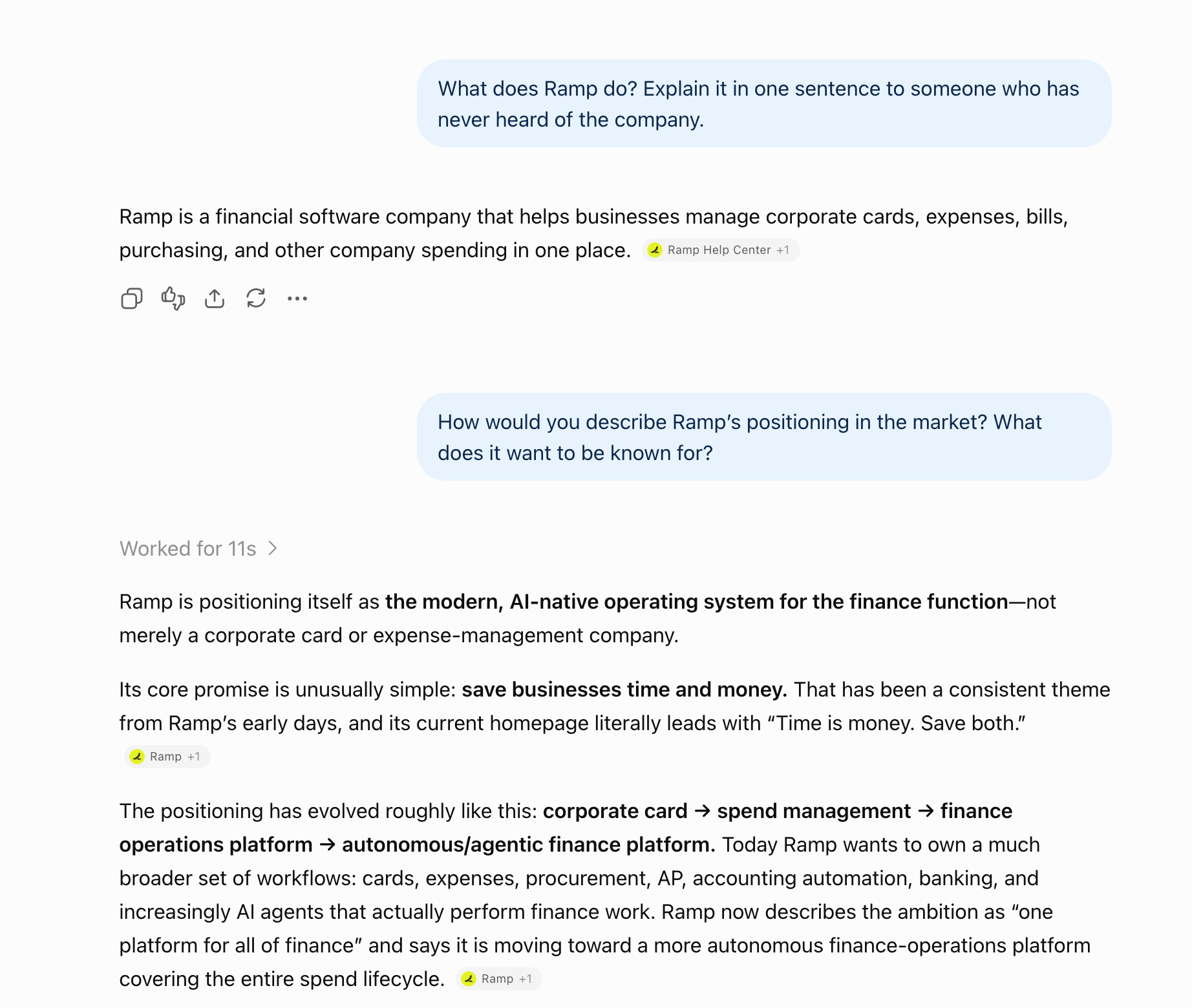
Ask any model about Ramp's positioning and it recites it almost word for word. ChatGPT called Ramp "the modern, AI-native operating system for the finance function," which reads like a line lifted from the brand book.
Then ask the question a real person asks. What does Ramp do? A corporate card and expense company. No AI, no agents, none of what Ramp's homepage leads with.
Harvey was the same. Ask about positioning and you get a company moving "from assistant to legal infrastructure." Ask what Harvey does and Claude says "essentially a very fast junior associate powered by AI." For a company trying to become the infrastructure the legal industry runs on, that is a rough introduction to a stranger.
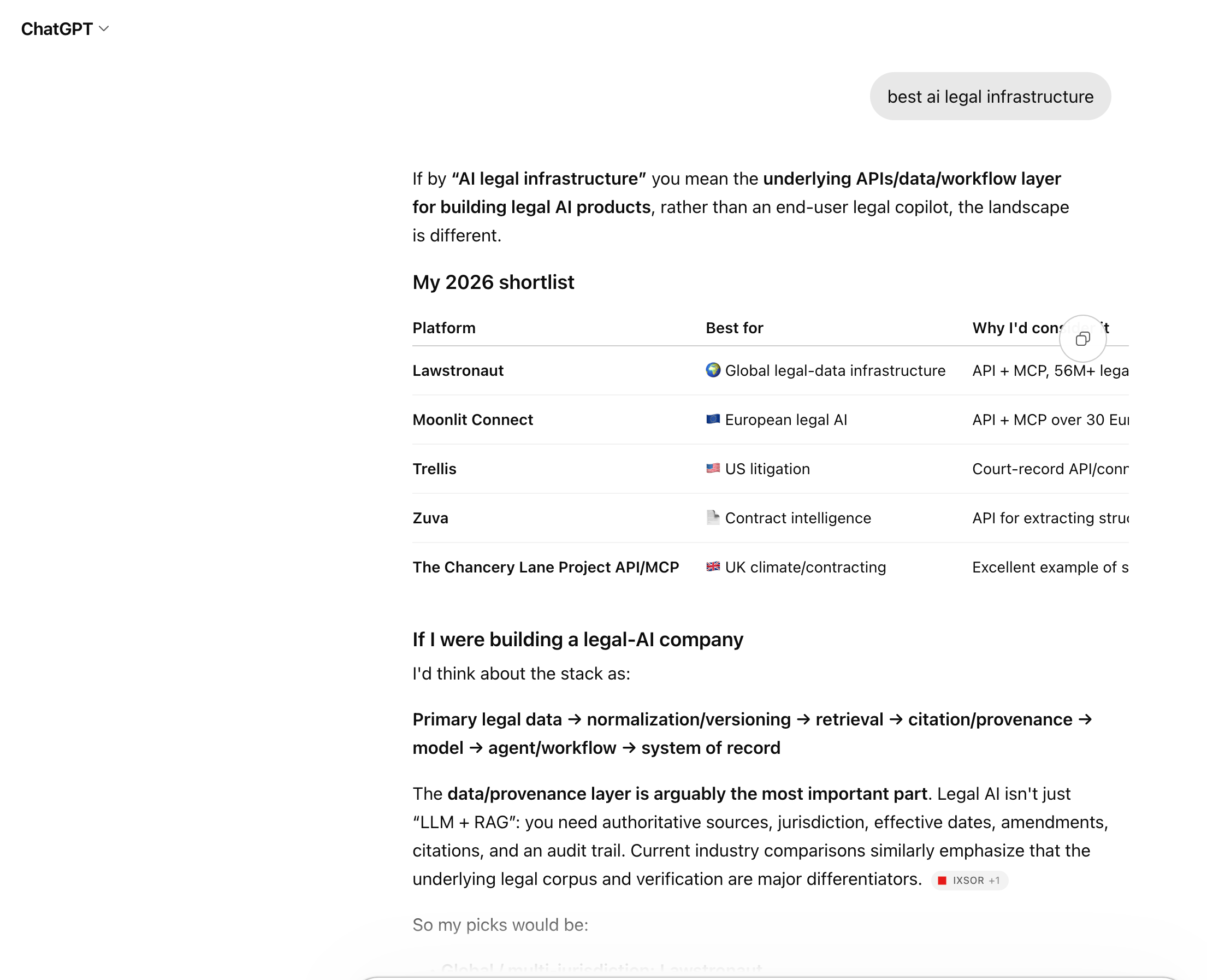
This happened with all four. The new identity is in there. It sits one question below where anyone searching would look.
Which makes the shallow question the important one. Nobody asks a model to analyse your positioning. They ask what you do, or they describe a problem and ask what to use. Increasingly their AI asks for them, and assembles a shortlist before a human reads anything.
Here are all four side by side. On the left, the answer to "what does X do?" In the middle, what each company leads with on its own homepage, captured the same day.
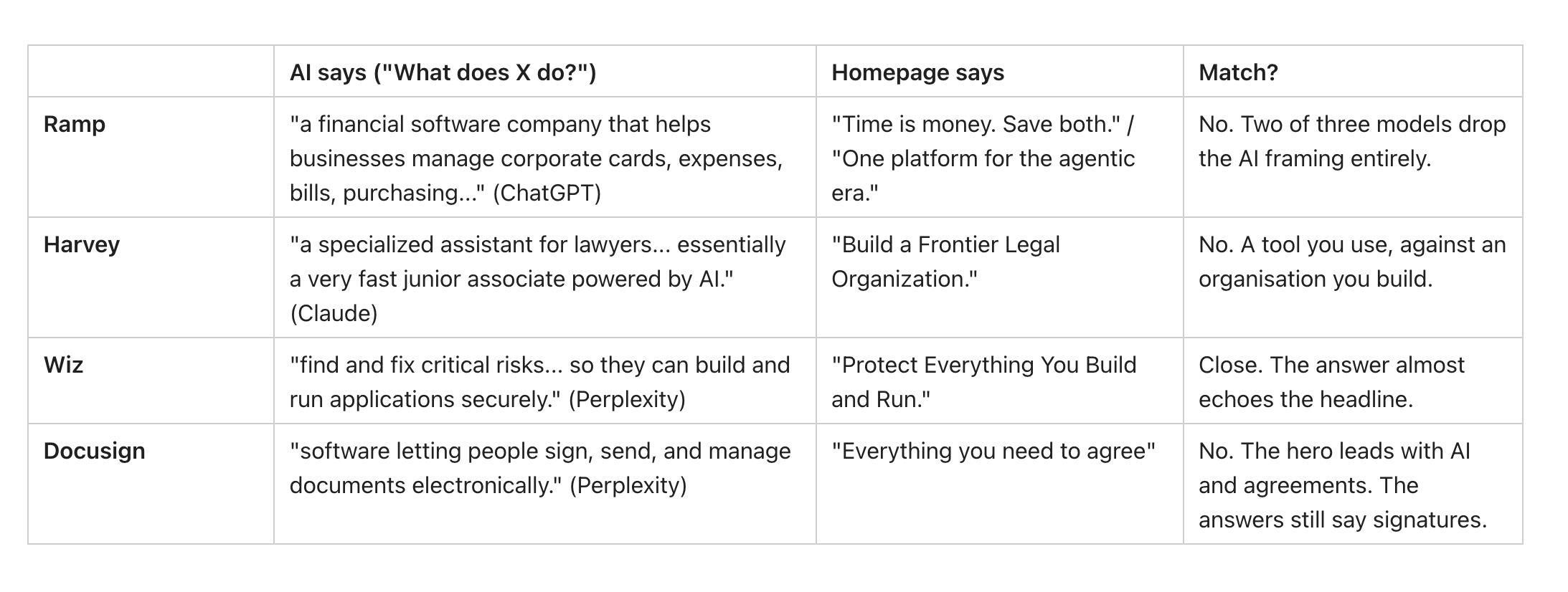
One of the four comes close. It is the one that has been saying the same sentence for years.
Part two: the five questions, and what each one tells you
Different questions test different parts of the problem. Run all five and you get a diagnostic rather than an opinion.
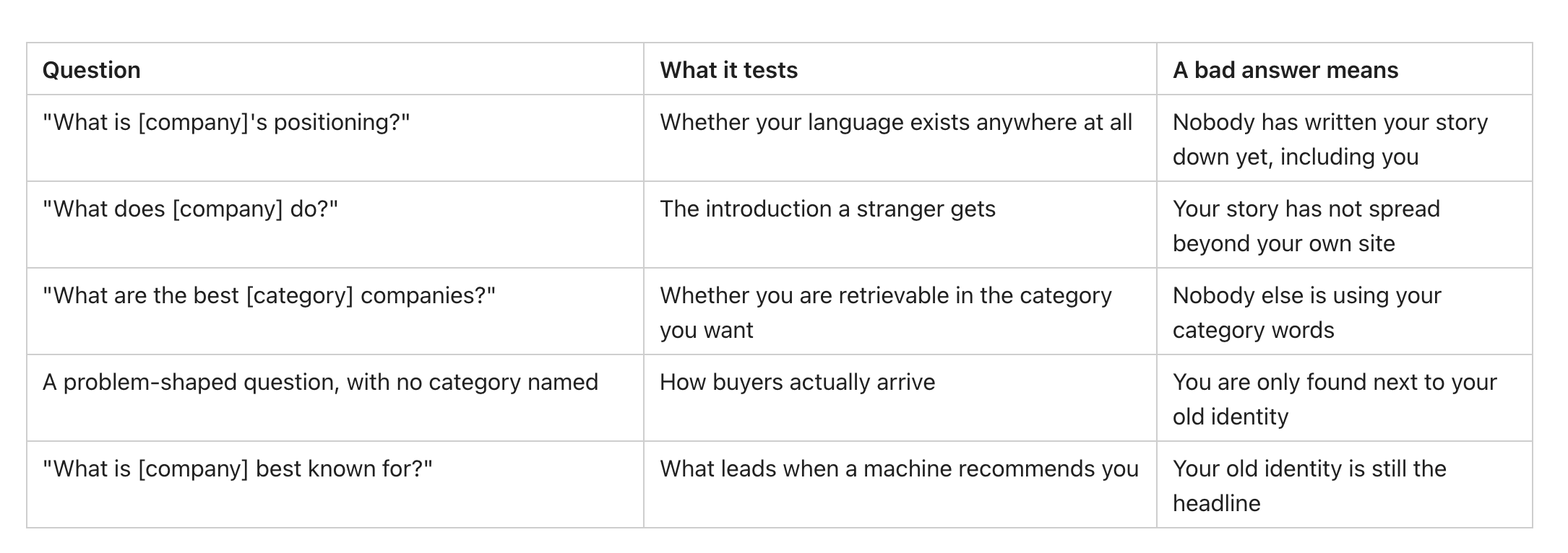
The first two are the pair from part one. Here is what the other three turned up.
The category question split along an interesting line. Asked for the best financial automation company, both Perplexity and ChatGPT put Ramp in the top three. Asked for the best AI legal infrastructure, Perplexity ranked Harvey first, and ChatGPT produced a list with no Harvey on it at all.That split is worth understanding. Perplexity searches the live web on every query. ChatGPT does so on roughly a third, and answers from training memory the rest of the time. The most likely reading is that Perplexity returned Harvey's self-description, which is published on the live web, while ChatGPT returned the market's verdict, which is what the world has written down about Harvey so far. The verdict is the one that has to change, and for Harvey it has not yet.
The problem-shaped question produced the sharpest finding in the exercise. Ask how to stop missing contract auto-renewals, then whether there is a tool for it, and Docusign surfaces. The problem sits right next to the product it is famous for.Now ask for the best tool to track obligations and deadlines across hundreds of agreements. That is precisely what Docusign's new category describes. Docusign does not appear.Recognition reached as far as adjacency to the old identity and stopped there. Worth testing in your own category, because if the pattern holds, a positioning more than one step from what you are known for will be missing from exactly the searches it was built to win.
The recommendation question showed how uneven progress can be across a set. Wiz came back with its current identity, the Security Graph and the platform. Docusign came back as "the standard" for signing, with Intelligent Agreement Management, the category it invented, described by Perplexity as something it is merely "pivoting toward."
Part three: then read the website
Having asked the models, we read every surface each company uses to describe itself.
The answers stopped being mysterious.
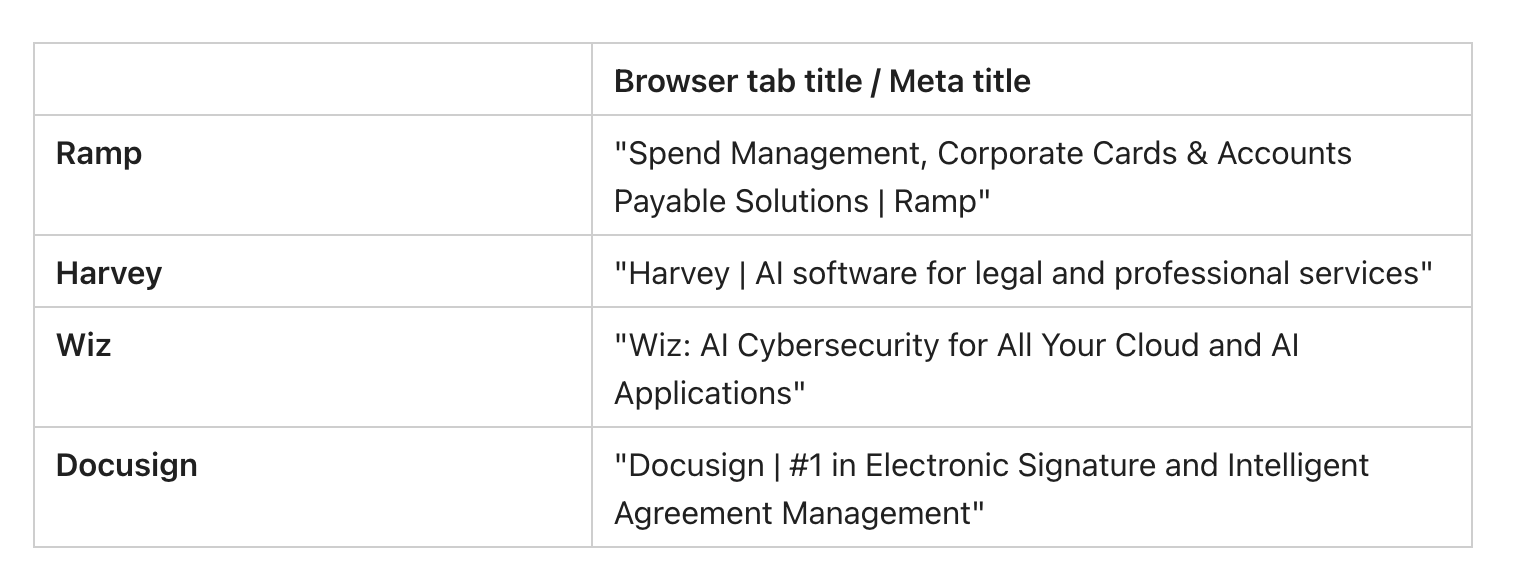
Start with the meta title - what you see in the browser tab. Almost nobody updates it, and both Google and the models read it.
Ramp
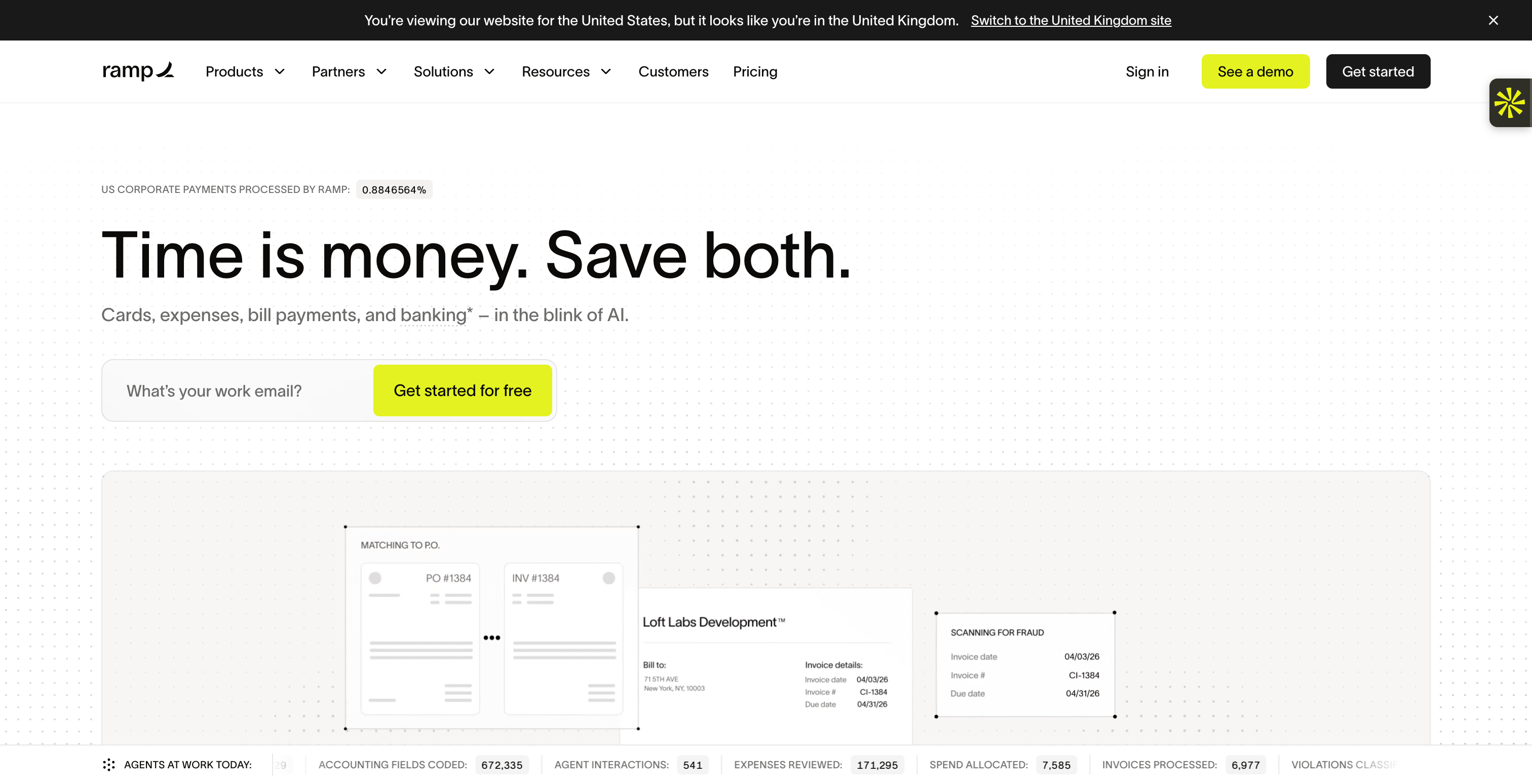
Ramp never names a category. The homepage says cards, expenses, bill payments and banking, then "One platform for the agentic era." The browser tab above it, which is the line Google has indexed for years, says corporate cards and accounts payable. The app stores say "the finance automation platform." The press page says "the finance operations platform." The 2026 press releases say "how companies save time and money on every dollar they spend."
Five surfaces, five different answers to what Ramp is, and not one of them agentic. The models are picking the version that appears most often.
Harvey
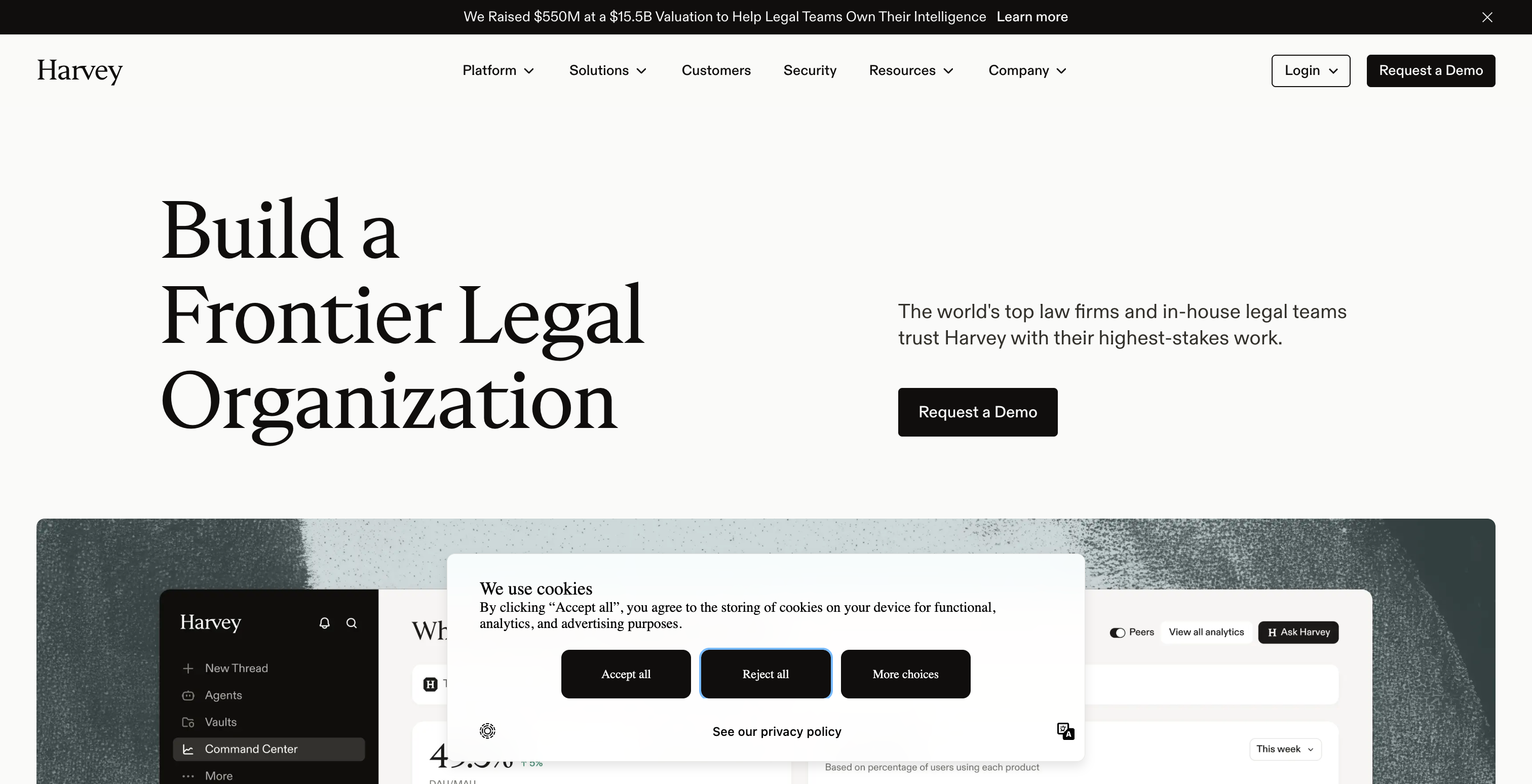
Harvey's hero never says what Harvey is. "Build a Frontier Legal Organization" describes something the customer builds. The plain description exists, and it is in the browser tab. You have to hover a tab to learn what the company sells.
The word infrastructure, which Harvey's own funding announcements are built on, appears nowhere on the homepage. The framing has moved again since. By September 2026 Harvey was describing itself as helping legal teams "own their intelligence." Three self-descriptions in six months, none of which reached the front page.
Wiz
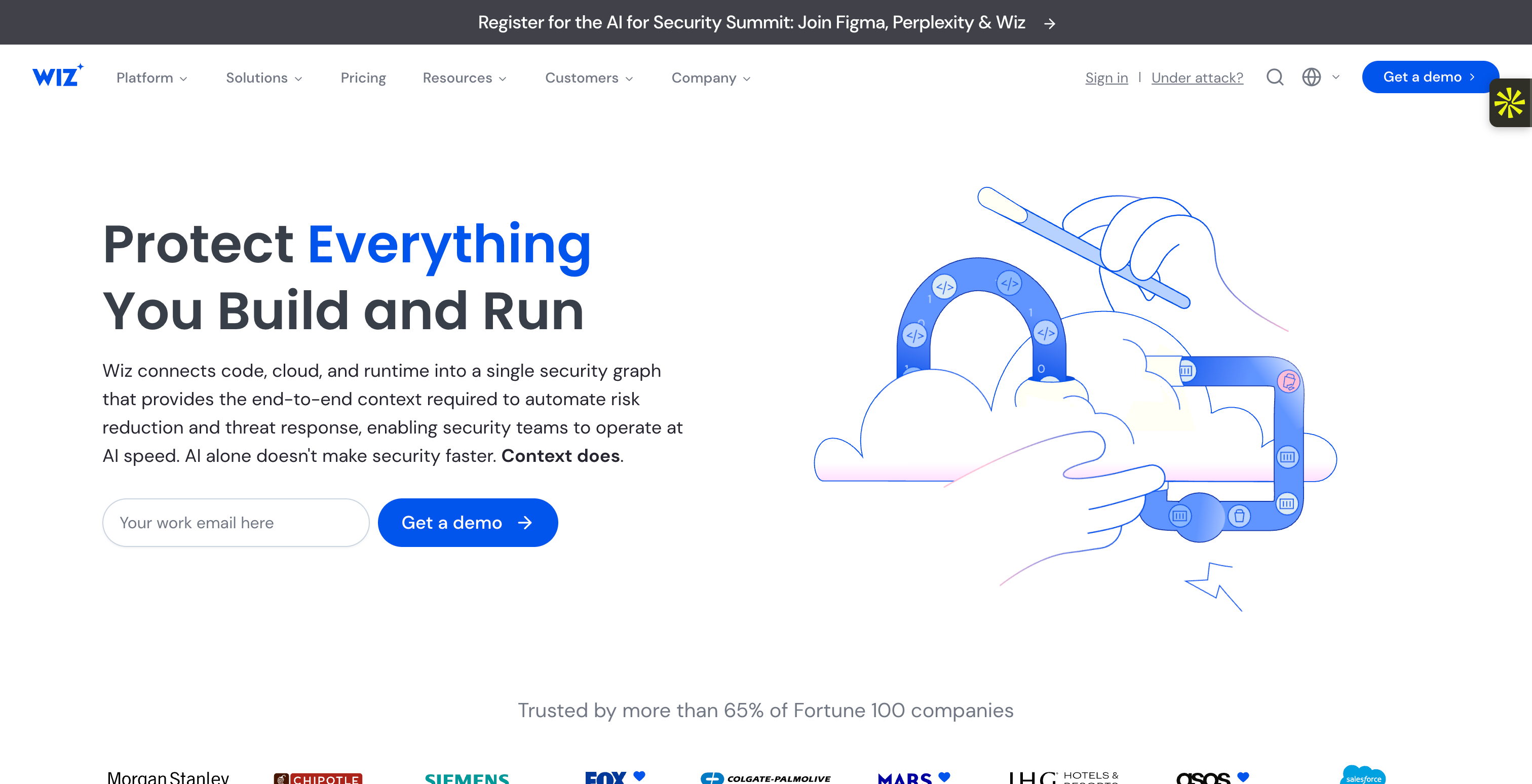
Wiz says one thing everywhere. The hero, the press boilerplate and the product pages all repeat the same code, cloud and runtime story. The models repeat it back almost word for word. This is the control case, and it is worth noting that when Google acquired Wiz for $32bn in March 2026 it kept the brand and left the messaging alone.
Even Wiz has a lag. It has pushed AI security language since late 2023. Wikipedia still opens with "cloud security company." Consistency speeds this up. It does not make it instant.
Docusign
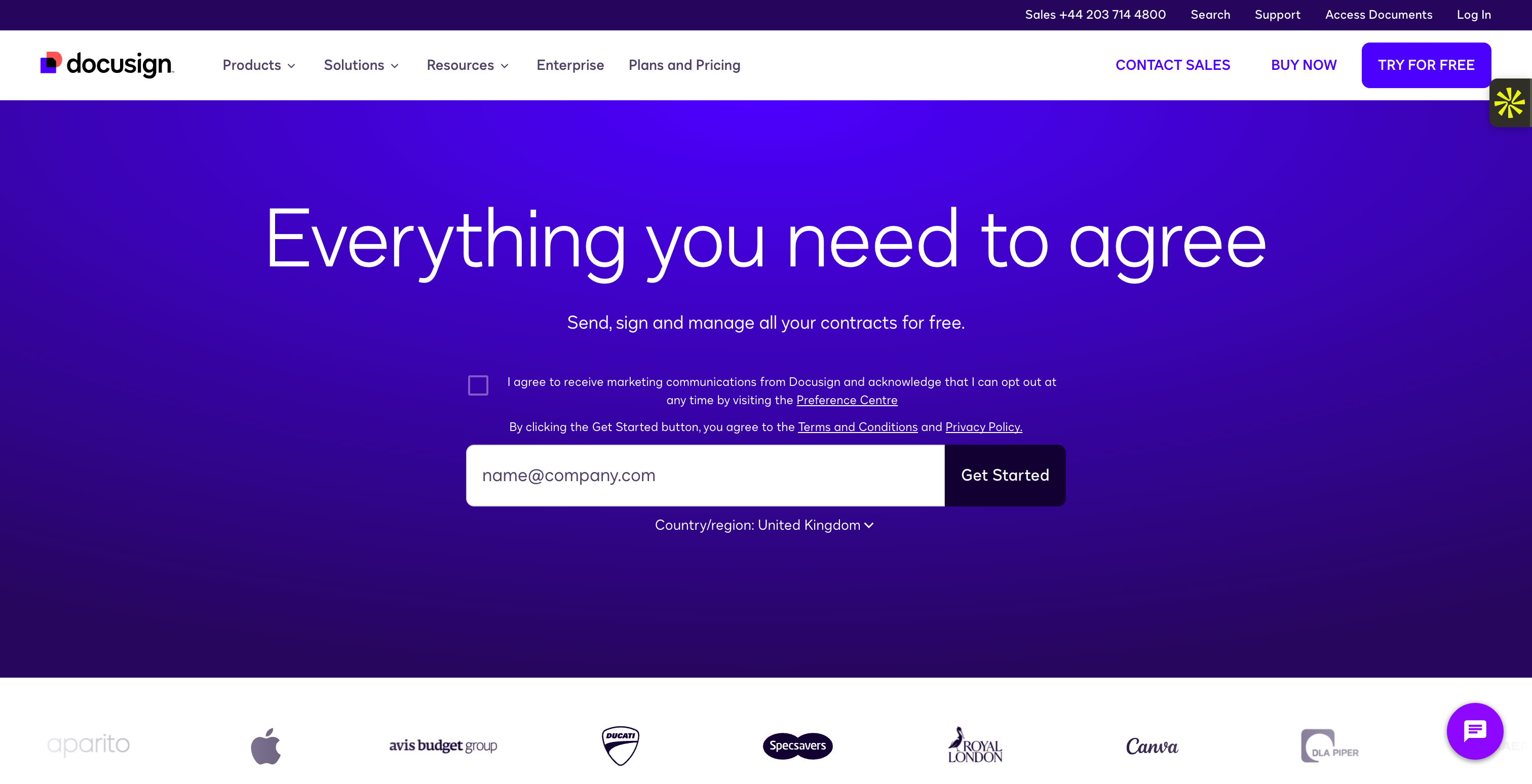
Docusign carries two identities at once. The tab title holds both. The Apple App Store leads with e-signature, "the world's #1 way for businesses and individuals to securely send and sign agreements." Google Play leads with the new one, "Docusign is now the Intelligent Agreement Management company." Same company, same week, two answers.Docusign announced its new category in April 2024. That is two and a half years of agreement language against twenty-three years of everyone, Docusign included, saying signatures.
Part four: Why this can't be fixed with markup
The obvious next move is technical. Add schema, add llms.txt, make the page easier for machines to read.The evidence against that is unusually clear.
Controlled testing on nearly two thousand pages that added structured data found no measurable change in AI citations against matched control pages.
Google's own guidance on AI search puts it plainly: there is no special markup you need to add.There are two reasons markup cannot reach this.
Most of the answer comes from outside your site. The models build their picture of you from everything ever written about you. Press, comparison sites, job listings, forums, customer language.
Roughly eight in ten sources cited in AI answers are third party. Your homepage is one voice against everyone else's, and making that one voice more machine-readable does nothing to the rest.
And in every case we looked at, the old story was still being told by the company itself. Ramp's old tagline is live on both app stores. Docusign's signature-first description is the opening line on Apple. The models are reading the old story off your own channels, which is the part you can fix this week.
Part five: what you can do about it
Audit your own channels first. Put every line in one document and check they say the same thing in the same words.
- Homepage hero and subhead
- Browser tab title and meta description, which are usually years older than the hero and almost never get updated
- Navigation labels
- Apple App Store listing
- Google Play listing
- Press release boilerplate
- The press page on your own site, which is usually different from the boilerplate
- LinkedIn About section
- X bio
- Founder and exec speaker bios
- Wikipedia, G2 and Crunchbase category
Every company we checked had at least two versions of itself live. Most had more. Nobody does this deliberately. Nobody owns the list.
Pick one category noun and stop moving. Plain words a stranger could repeat back, not a positioning statement. Then hold it, long past the point where your team is bored of saying it, because other people only start repeating a phrase after you have stopped noticing you say it. Harvey has had three positions since March. None of them has had time to travel.
Check the distance. If your new category sits more than one step from what you are already known for, expect the Docusign problem. Bridge it deliberately, with content and language that connects the old identity to the new one, rather than assuming people will make the jump on their own.
Get the phrase into other people's copy. This is the part that moves the answer and the part nobody wants to do,, [but it rarely gets done] because it is slow. Press coverage, comparison and best-of listicles, review sites, analyst categories, customer case studies published on customer domains. Start with the cheap ones. Wikipedia, G2 and Crunchbase categories are mostly free to fix, and they feed both search and the models.
Re-run the five questions quarterly. Same questions, same engines, several runs of each, logged out. Keep the screenshots and date them. The movement between quarters is the only real measure you have.
Expect it to take time. Nobody publishes retraining schedules, so anyone offering you a recovery date is guessing. Wiz has the most disciplined messaging of the four and is still carrying an old label after nearly three years.The models are a fast and slightly brutal way of measuring the distance between what you have decided about yourself and what you have managed to get other people to repeat. Closing that distance is repetition, in other people's words, over a long time.
Homepage, browser tab, app store and press copy for all four companies captured 11 September 2026. Model answers captured across ChatGPT, Claude and Perplexity in September 2026.